VPS vs Dedicated Server: Which Is Better for Your Business?
Introduction
When choosing infrastructure for a website, application or business system, one of the first decisions is whether to use a VPS or a dedicated server. Both options can support business workloads, but they provide different levels of hardware access, resource allocation and operational flexibility.
The right choice depends on your performance requirements, budget and expected growth.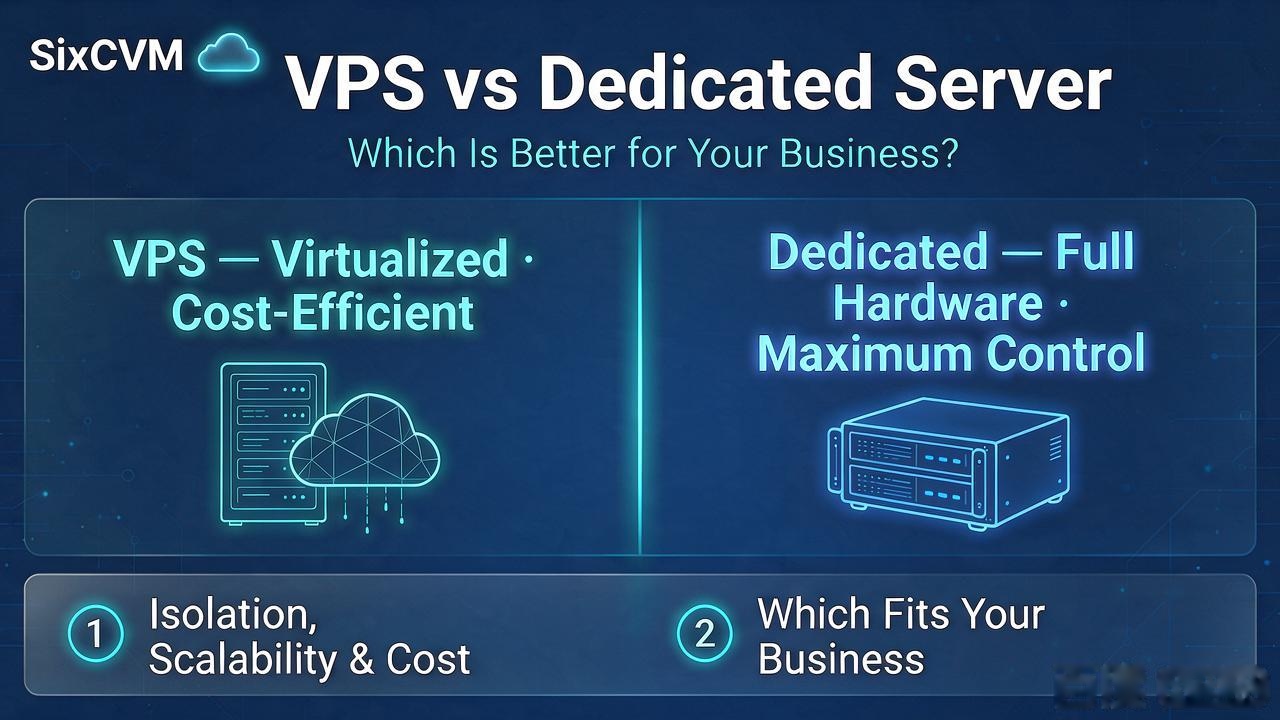
1. What Is a VPS?
A Virtual Private Server is a virtual machine running on a physical server. A virtualization platform divides physical hardware into multiple virtual server environments. Each VPS receives allocated resources such as CPU, memory and storage.
VPS hosting is often suitable for small and medium-sized websites, development environments, business applications, APIs and databases, and multiple low-to-medium traffic websites. It is usually a more accessible starting point than renting an entire physical server.
2. What Is a Dedicated Server?
A dedicated server provides physical hardware resources for one customer. Instead of sharing the physical machine through virtualization with other customers, the customer rents the server's hardware resources.
Dedicated servers can be suitable for high-traffic websites, large databases, enterprise applications, resource-intensive workloads and custom software environments. They may also provide more control over hardware and system configuration.
3. VPS vs Dedicated Server Comparison
The table below summarizes typical differences. Actual performance depends on the hardware, virtualization configuration, network and provider service scope.
4. Which Should You Choose?
Choose a VPS if you are launching a website, running a small application or need a flexible environment with a lower initial cost. Choose a dedicated server if your workload requires exclusive physical hardware, substantial memory, specialized storage or more control over server resources.
Before upgrading from a VPS, benchmark your application and identify the actual bottleneck. A dedicated server is not automatically necessary for every growing website.
5. SixCVM Server Options
SixCVM provides cloud VPS and dedicated physical server products across multiple regions. Its dedicated server page describes hardware configurations using Intel Xeon processors, DDR4 memory, SSD/HDD storage and different bandwidth options. Check the current page for exact available configurations and service terms.
Hosting comparison
|
Factor |
VPS |
Dedicated Server |
|
Infrastructure |
Virtual machine |
Physical server |
|
Hardware access |
Virtualized resources |
Dedicated hardware |
|
Cost |
Generally lower |
Generally higher |
|
Scalability |
Often easier to change plans |
Depends on hardware and provider |
|
Customization |
Depends on virtualization |
Usually broader hardware control |
|
Typical use |
Websites and applications |
High-load and enterprise workloads |
Frequently Asked Questions
Is a dedicated server faster than a VPS?
It can provide more predictable access to physical hardware, but actual performance depends on CPU generation, storage, memory, network and workload.
Can I upgrade from VPS to dedicated hosting?
Yes, migration is possible, but the process depends on your application, operating system and data architecture.
Is VPS enough for an e-commerce website?
Many e-commerce websites can run on a properly configured VPS. Required resources depend on traffic, database load and application design.
Does a dedicated server include management?
This depends on the provider's service scope. Check whether operating system management, hardware replacement, backups and application support are included.
Suggested Internal Links
Call to Action
Explore SixCVM dedicated servers: https://www.sixcvm.com/en/physical-server-purchase.html