How Do Watering Hole Attacks, Third-Party Vulnerabilities and SQL Injection Actually Get In — and Which Layer Should You Fix First?
Attack techniques keep evolving, but the entry points a business really needs to watch are remarkably stable. Instead of chasing every new term in the news, it helps to start with one observation: attackers prefer the layers you depend on but do not fully control.
In one sentence: entry points into a web server fall into three groups — the external sites your team trusts, the third-party vendors you rely on, and the application code you wrote yourself. What these three share is that the defence line sits outside your hands, so hardening has to expand from "secure my own machine" to "secure my own dependencies."
This article helps operators recognise attack patterns and harden their own systems. Testing or attacking servers you do not own is illegal.
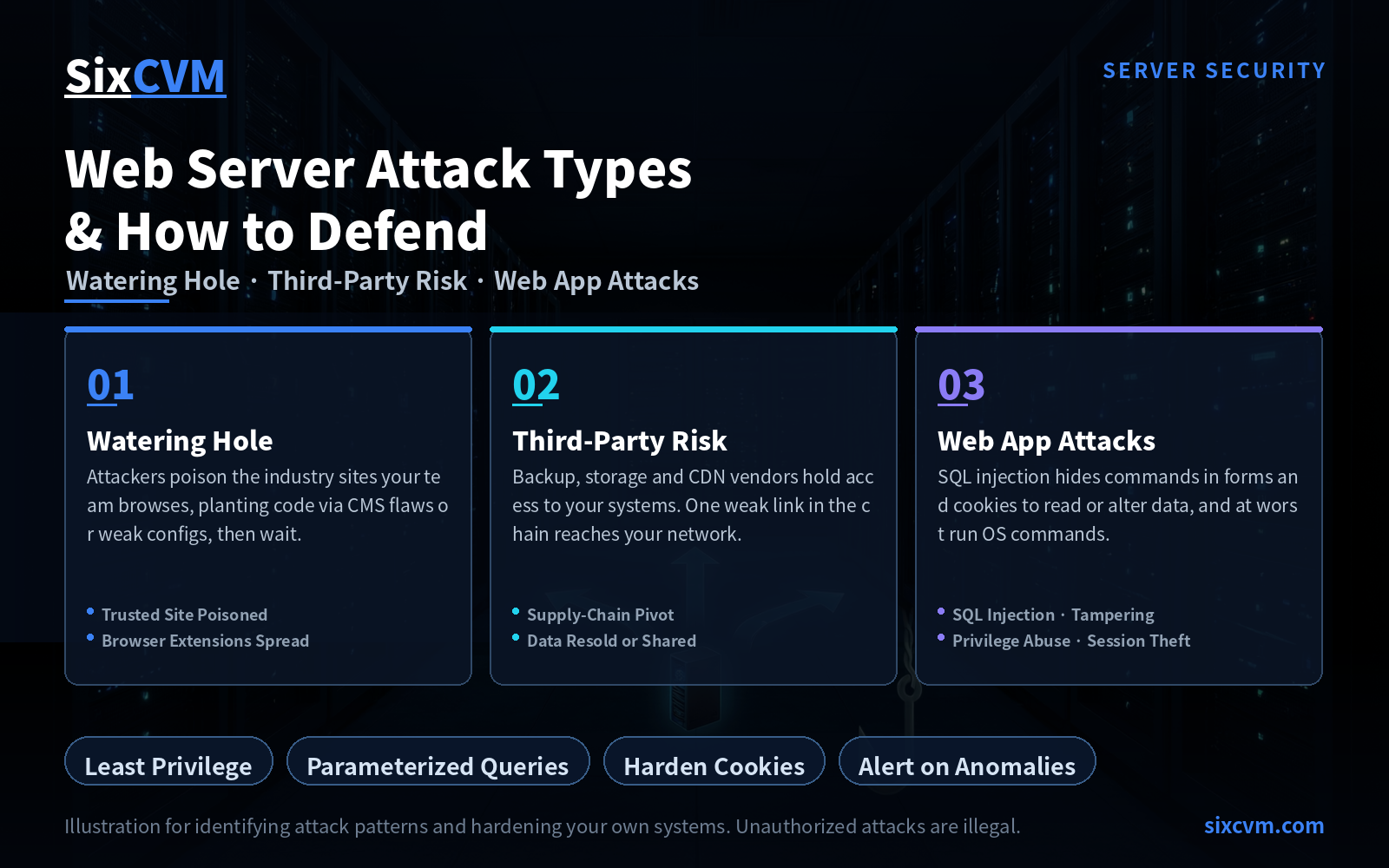
1. Watering Hole Attacks: Traps Planted on the Route You Walk Daily
The name comes from hunting. A predator does not chase its prey; it waits at the water hole the herd must visit. Online, the water hole is the industry site your team returns to again and again for work — a supplier portal, a trade forum, a niche news site.
The attacker finds such a site, exploits a vulnerability in the CMS component it runs or a misconfiguration in its code, and quietly plants malicious code in the page. You did nothing wrong. You simply visited a site that looked perfectly normal, and a script ran in the background.
Three traits are worth noting:
-
The attack surface is not in your data centre. Hardening your own servers cannot stop it, because the malicious code runs on someone else's site.
-
It stays hidden for a long time. Compromised sites are often discovered weeks or months later, while visitors remain unaware.
-
The payoff targets credentials and payments. Common goals are fake login forms or checkout pages that quietly move users from the legitimate site to a look-alike, spreading further through browser extensions.
What to do: restrict browsing from high-privilege accounts; enforce multi-factor authentication on admin panels so a single leaked password is not fatal; keep browsers and plugins updated and limit extension permissions.
2. Third-Party Vulnerabilities: The Side Door Is Often Easier Than the Front
As a business grows, relying on external services becomes unavoidable — backup, object storage, monitoring, CDN, helpdesk, developer tooling. The more convenient the integration, the more access the vendor typically holds. Read-only access to your data is the mild case; some services effectively receive a channel that reaches your data centre or production systems.
The attacker's logic is simple: rather than breaking your well-hardened perimeter, break the small vendor you trust that is already connected to you. Once the vendor's credentials are taken, the existing integration becomes a pivot into your network — and in your logs, the traffic still looks like it came from a trusted partner.
Beyond compromise, there is a second risk that is often overlooked: data resold or shared in violation of your expectations. Some service terms permit customer data to be used for "related analysis" or "commercial partnerships," which can breach your own confidentiality duties and expose your customers' information beyond your control.
What to do: before signing, map exactly which permissions the vendor needs and insist on least privilege; isolate third-party access rather than letting it share a plane with the core production network; periodically review which vendors can still connect in and cut integrations you no longer use; put data-use and resale restrictions into the contract.
3. Web Application Attacks: Two Doors — Input and Credentials
Your own application is where attackers probe most persistently, because you wrote the code and no one will patch its gaps automatically. SQL injection is the most typical and enduring example.
The mechanism is not complicated. The application concatenates user input straight into a database query. An attacker then supplies content carrying extra instructions through a form, a URL parameter or a cookie, turning a statement that should have fetched one record into one that can read an entire table, modify data, or delete it. If the database account holds excessive privileges, the attacker can push through to the operating system and issue commands directly — escalating the incident from data exposure to a fully compromised host.
Beyond forms, cookies are the underestimated second door. Along the path from client submission to server-side handling, the cookie carries session identity. If it can be tampered with, an attacker may be able to rewrite someone else's session — usually an administrator's — into their own hands and walk into the back office without ever logging in.
What to do: route every database query through parameterised (prepared) statements, never string concatenation; grant database accounts only the privileges the application needs and never connect production workloads with a high-privilege account; set the HttpOnly, Secure and SameSite attributes on cookies and validate session identifiers for integrity; alert on failed logins, malformed parameters and back-office access.
4. Quick Reference: The Three Attack Types
|
Attack type |
Where the attacker enters |
The layer you do not control |
Fastest effective action |
|---|---|---|---|
|
Watering hole |
Industry sites your team visits often |
The security posture of external sites |
Enforce MFA on admin panels, tighten browser extensions |
|
Third-party vulnerability |
Vendors holding access to your systems |
Your partners' security level |
Least privilege, isolate vendor access, review and cut links |
|
Web application attack |
Application forms, parameters, cookies |
Gaps in your own code |
Parameterised queries, cookie hardening, behavioural alerts |
5. What Order Should Hardening Follow?
The three entry points differ widely in cost, so it makes sense to sequence them by return on effort:
-
Fix what you fully control first — parameterised queries, cookie attributes, least-privilege database accounts. You can decide these unilaterally and need no one else to cooperate.
-
Then tighten the dependency surface — review each third-party service's authorisation scope and close the access paths you do not use. The payoff is high and a single configuration often holds for a long time.
-
Finally address human habits — multi-factor authentication, limiting what high-privilege accounts browse, and building judgement about clicking external links. This step is hardest to quantify but does the most to lower the success rate of watering hole attacks.
6. FAQ
Q1: If I harden my own servers strictly, do I still need to worry about watering hole attacks?Yes. The malicious code runs on the third-party site, and no amount of server hardening stops a script inside a browser. The right response is to reduce the consequences of a single slip — use multi-factor authentication so a leaked credential is not fatal.
Q2: How do I judge whether a third-party service is asking for too much access?The most practical question is: if this vendor were fully compromised today, how much of mine could an attacker reach through it? If the answer involves production databases or internal hosts, the access is excessive and should be split or isolated.
Q3: If I use an ORM framework, am I safe from SQL injection?A framework blocks most concatenation scenarios but does not guarantee anything. Raw SQL fragments, dynamic ordering or table-name concatenation, and misuse of string formatting can still open the door. The principle remains separation of parameters from statements.
Q4: If a cookie already has HttpOnly set, is that enough?HttpOnly only solves one problem: scripts cannot read the cookie. It does not prevent tampering or a guessed session identifier. Use all three attributes together — HttpOnly against reading, Secure against plaintext transport, SameSite against cross-site carrying.
Q5: For an SMB with no dedicated security team, what should be done first?Two things that need no extra headcount: turn on multi-factor authentication for all admin logins, and convert every database query to parameterised form. Once done, these block the most common payoff paths of two of the three attack types above.
About SixCVM
SixCVM is a cloud server provider built for cross-border business and latency-sensitive applications, operating seven core nodes across Hong Kong, Japan, the United States, Korea, Singapore, Taiwan and Vietnam on CN2 GIA and BGP optimised routes, with Hong Kong latency as low as under 10ms. Its portfolio covers cloud servers (VPS), GPU servers (NVIDIA A100 / H100 / RTX series), dedicated servers, bare metal servers and domain registration, all on NVMe SSD with minute-level provisioning, elastic resizing, snapshot backup and load balancing.
For the three entry points discussed here, SixCVM offers baseline network-layer protection and system hardening guidance, supports rapid rollback to a pre-incident state via snapshots, and lets you run multiple instances behind a load balancer within the same availability zone so a single breach does not take down the whole service. Combined with a 99.9% SLA and 24/7 technical support, it adds another layer of assurance for business continuity.
This article is intended solely to help users identify attack patterns and harden their own systems. Attacking servers without authorisation is illegal — please do not attempt it.
Related: Visit the SixCVM Server Security Center for the complete guide to protecting, detecting, and responding to server attacks.