Japan vs. Korea VPS: A Practical Guide to Pros, Cons, and Who Should Choose What
For website operators whose primary audience is in Northeast Asia, Japan and South Korea VPS have long been popular options. Both regions share one core advantage: no ICP filing required, instant deployment — skipping the weeks-long review process that domestic hosting requires, which is a huge draw for projects that need to go live fast.
But while Japan and Korea are geographically close, the actual user experience differs in important ways. In this guide, we break down the pros and cons of VPS hosting in both regions across four dimensions — connectivity, policy flexibility, language barriers, and pricing structure — to help you figure out which one fits your needs best.
Two Shared Strengths: Why These Northeast Asia Nodes Stand Out
1. Excellent Average Latency Across Asia
South Korea and Japan consistently rank among the top countries worldwide for broadband penetration and average internet speed, with extremely mature network infrastructure. For users in mainland China, performance won't match what local users experience — international egress bandwidth and routing policies see to that — but thanks to the relatively short geographic distance, latency typically lands in the 60–120ms range, which is noticeably faster than the 180ms+ you'd get from a US-based server.
This makes both Japan and Korea VPS particularly well-suited for foreign trade companies, e-commerce stores, gaming services, and content sites whose audience is concentrated in Northeast or Southeast Asia — the overall access experience across the region is well-balanced.
2. No Filing Required — Fast Launch and Operational Flexibility
Just like US hosting and Hong Kong hosting, Japan and Korea VPS don't require ICP filing. You can bind your domain and go live immediately after purchase, saving valuable lead time. For fast-moving startups, test sites, and agile SMB projects, this is a huge advantage.
One important note, though: to avoid collateral damage from other sites on the same server getting their IP blocked due to violations, we strongly recommend going with a dedicated IP plan. It costs a bit more, but it significantly reduces the risk of being caught up in someone else's problems — well worth it for any serious long-term project.
Two Important Caveats to Know Before You Buy
Despite their advantages, Japan and Korea VPS aren't without trade-offs. The following two drawbacks catch many buyers off guard, so it's worth evaluating them upfront.
1. Language and Support Are the Biggest Barriers
This is the most common pain point for international users. Most local IDCs in Japan and Korea only offer their websites in the native language. Since Japanese and Korean proficiency is far less common than English among Chinese-speaking teams, simply navigating the control panel and reading product documentation can be a headache.
The bigger issue is post-sales support: most local providers' technical support teams only work in their native language. When you run into server failures, billing issues, or network anomalies, a language barrier can drastically slow down troubleshooting — sometimes costing you critical response time. If your team doesn't have solid Japanese or Korean skills, this is a significant hidden cost.
2. Higher Prices, and Billing Rules With Fine Print
In terms of raw pricing, Japan and Korea VPS generally cost more than US hosting — and sometimes even more than certain Hong Kong plans. This reflects the higher land, labor, and bandwidth costs in both markets. If you're working with a tight budget, it's something to weigh carefully.
There's also a specific quirk of the Korean hosting market worth noting: the first month's fee is often significantly higher than the renewal price, because an installation and setup fee is bundled into the initial charge. What's more, some providers charge per-incident fees for OS reinstalls down the line. These hidden costs can easily push you over budget if you don't read the fine print up front.
Who Should Actually Choose Japan or Korea VPS?
To wrap up, Japan or Korea VPS are a great fit if you fall into any of these groups:
- You run an e-commerce or foreign trade business serving mainly Japan, Korea, or Northeast Asia;
- You're running latency-sensitive projects (lightweight games, online tools, real-time applications);
- You need fast deployment without filing requirements for test sites or startup projects;
- Your team has working Japanese or Korean language skills to communicate smoothly with local providers.
If your audience is mainly in mainland China and speed is your top priority, Hong Kong VPS or CN2-optimized US hosting may offer better value. If you're budget-constrained and need lots of bandwidth and IPs, US hosting remains the most affordable option.
About sixcvm
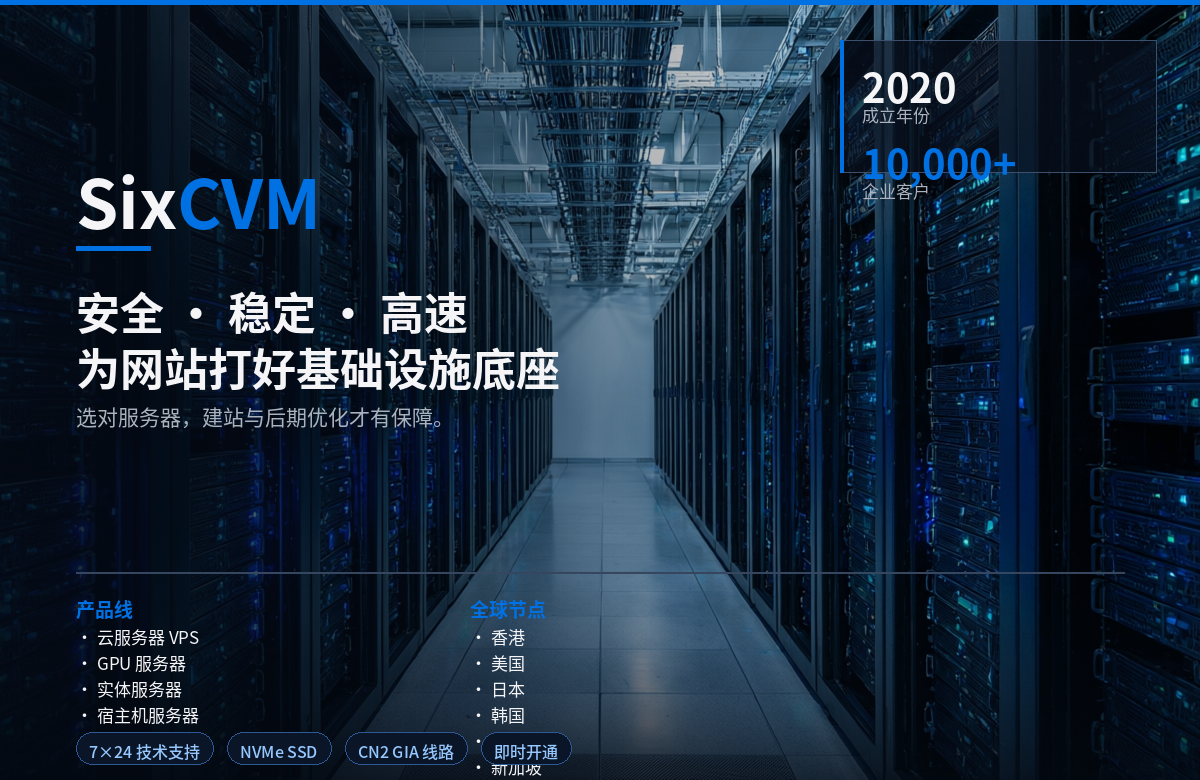
sixcvm is an established cloud infrastructure provider with years of industry expertise, offering a full product lineup including elastic cloud instances, dedicated servers, multi-IP station cluster servers, and high-protection DDoS solutions — serving everyone from individual webmasters to mid-sized enterprises.
With premium data center resources across multiple global core locations — including Hong Kong, the US, and Japan — and optimized network routes such as CN2 GIA, sixcvm delivers low-latency, high-stability connectivity whether your audience is in China or overseas. The platform features a full-featured, intuitive control panel with one-click OS reinstallation, on-demand scaling, and snapshot backups — all available in Chinese with no language barrier. Backed by a 24/7 Chinese-speaking technical support team, sixcvm lets you focus on growing your business instead of worrying about infrastructure and language issues.