Can Encrypted Traffic Be Used to Breach a Server? Why "Encrypt Everything" Became the Attacker's Favourite Hiding Place
Some people search "how to breach a server" with motives they shouldn't have. This article contains no attack instructions. It answers a more practical question from the defender's side: once nearly all traffic is encrypted, how does an intruder walk straight past your inspection devices — and how do you light that path back up?
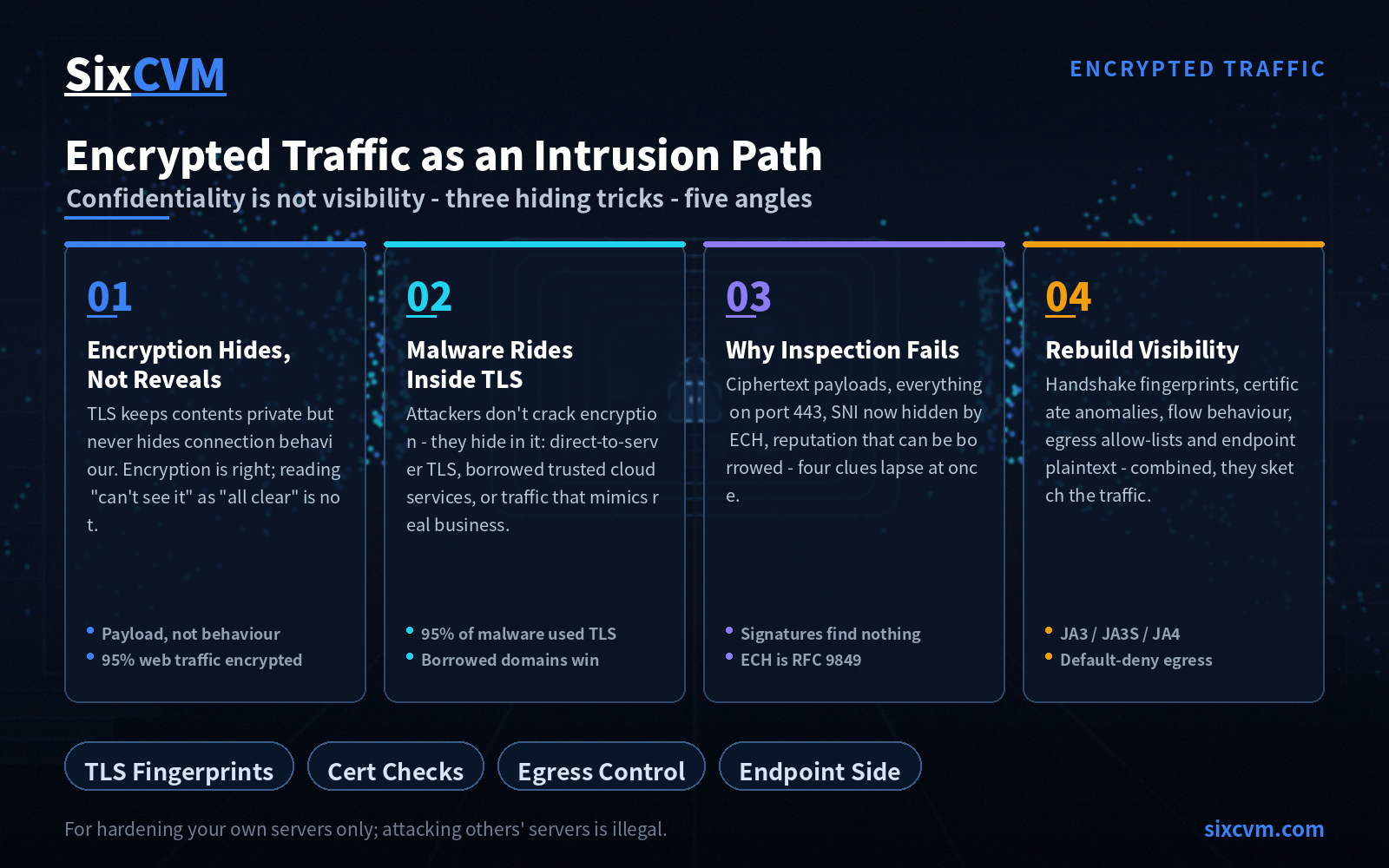
The conclusion in one line: TLS guarantees that contents can't be read; it has never promised that behaviour can be seen. Intruders don't need to break encryption — they only need to stay inside it. In one threat report covering the first half of 2026, 95% of blocked malware arrived over TLS, while only about one in five deployed devices actually decrypts encrypted traffic for inspection.
This article helps operators harden their own servers and networks. Testing or attacking systems you are not authorised to touch is illegal.
1. First, a premise to correct: encryption is essential, but it provides no visibility
The value of SSL/TLS isn't in dispute — it prevents eavesdropping, tampering and man-in-the-middle attacks, and it is the foundation of every online service today. The problem lies in a side effect that is rarely spelled out: while encryption shuts out outside eavesdroppers, it also shuts out you.
One number makes the situation clear: HTTPS adoption in global web traffic has passed 95%. Which means "just inspect the unencrypted traffic" stopped being an option long ago — you either face encrypted traffic, or you see nothing at all. And because encryption itself is correct and must keep spreading, the problem can't be solved by turning it off.
A closer analogy is a voice-changer phone call: you can't hear what was said, but who was called, for how long, how often and at what hour all remains with the carrier. Encryption protects the payload; it does not protect connection behaviour. That distinction is the foundation for everything below.
2. How intruders bury malicious traffic inside encrypted channels
Method one: connect directly to their own server, wrapped in standard TLS
The cost is close to zero. Any malware development framework today ships with a mature TLS library, so attackers don't need to invent a cipher — they just call one. The moment it's switched on, no plaintext signature remains in the payload: command strings, echoed output and uploaded filenames all vanish.
The trade-off is that a self-hosted server has poor IP and domain reputation and is easy to block. Hence the natural evolution into method two.
Method two: ride on trusted services (parasitise a high-reputation domain)
Hide the control channel behind a well-known CDN, cloud API, SaaS platform, code-hosting service or even a public collaboration or social platform.
The benefits are comprehensive: excellent domain reputation, a certificate issued by a legitimate authority, a clean IP, and an ISP and address range that look entirely normal. If the defender runs an allow-list strategy, that very allow-list is what opens the door. A 2026 threat report already documents this trend clearly — masking exfiltration through trusted public APIs and services is now mainstream, and web-protocol command-and-control accounts for 78.2% of techniques observed.
Method three: make the behaviour look like ordinary business traffic
Heartbeat intervals, packet-length distributions, request headers and request paths all mimic real traffic. More aggressive samples have moved to HTTP/3 and gRPC, hiding the protocol-level metadata inside the encryption as well.
What all three methods share is that not a single cipher is "broken". That is why upgrading the cipher suite or lengthening the key does nothing for this problem.
3. Why traditional inspection fails: four clues lapse at once
|
The clue that used to work |
What encryption did to it |
|---|---|
|
Payload content |
The payload is ciphertext; signatures and regex have nothing to match |
|
Port number |
Nearly every service runs on 443; the port points to nothing specific |
|
Server Name Indication (SNI) |
ECH is now the RFC 9849 standard — you may not even see which domain was visited |
|
Domain / IP reputation |
Reputation feeds lag by nature, and attackers borrow precisely the best-reputed domains |
With all four failing together, the inspection paradigm has to change at its foundation: from "read what the content says" to "pick out what behaves oddly" — finding anomalies by their traces, not their content, inside a pool full of legitimate encrypted traffic.
4. An easily overlooked backlash: the inspection device itself gets crushed
The most direct way to see content again is to decrypt it. But decryption is an extremely compute-heavy operation: independent studies put the figure at up to a 90% drop in firewall performance once SSL/TLS decryption is enabled. So defenders land in a dilemma — decrypt and you see nothing else; decrypt everything and you become the bottleneck.
More importantly, that dilemma can itself be exploited: flood an inspection device with encrypted sessions until its compute and session table are exhausted, turning your own security appliance into the point of failure. This is resource-exhaustion at its core, the same logic as a volumetric attack — except the target is not your application server, it is your security device.
So the right answer is not "decrypt everything" but doing two things at once: selective decryption, plus detection that works without decryption. The next section is the second half.
5. Rebuilding visibility without decrypting: five angles
① Handshake fingerprints (JA3 / JA3S / JA4)
The first step of a TLS handshake is the client's ClientHello, which states the protocol versions it supports, its cipher-suite list and its extensions in order. These fields are plaintext, and different TLS implementation libraries arrange them quite consistently — much like handwriting, each library has its own layout habits.
The most common real-world picture: office browsers and cloud SDKs have stable fingerprints that match a public fingerprint library; malicious samples that statically link OpenSSL or use Go's built-in TLS stack look markedly different from mainstream clients, often at a glance.
How to deploy it: collect ClientHello fingerprints in your own environment, build a fingerprint allow-list, and alert on clients outside it. One clarification — ECH encrypts sensitive fields such as SNI, but does not hide the whole set of negotiated parameters in the ClientHello, so this path stays open.
② The certificate layer
Certificates are visible without decryption: self-signed, an unfamiliar issuer, an abnormally short or long validity period, a name that doesn't match the domain being accessed, or a certificate that doesn't fit the host's purpose (an internal service presenting a public certificate, or the reverse). These are all solid alert conditions.
③ The traffic-behaviour layer
This layer watches how connections are made, not what is sent:
-
Periodic heartbeats: intervals that are extremely stable are a machine signature; people aren't that precise
-
Up/down asymmetry: upload far exceeding download usually means data is being carried out
-
Overly regular packet-length distributions and highly uniform connection durations
-
Deviation from baseline: first establish a traffic baseline for similar assets, then alert on departures
④ Egress control (the best value for effort)
The idea is simple: don't police what is sent, police where it goes. Deny all outbound connections by default and allow only the destinations the business genuinely needs.
The power of this step is that it requires reading no ciphertext at all — if the control channel can't phone home, the intrusion loses its purpose. Combined with domain, IP and address-range allow-lists and periodic review, the cost is far below buying decryption hardware.
⑤ Endpoint-side detection
On the final leg, TLS has already terminated and the plaintext is right there on the endpoint: host logs, process lists, outbound connection records and endpoint detection and response tooling all see the restored content.
This is also the standard answer to "it's encrypted, so you can't see it" — when the middle is invisible, move the detection point to the last leg.
6. Observation-angle comparison table
|
Angle |
What to look at |
Why it helps |
Setup cost |
|---|---|---|---|
|
Handshake fingerprint |
JA3 / JA3S / JA4, QUIC version, extension set |
Malware TLS stacks differ sharply from mainstream clients |
Low (passive capture) |
|
Certificate traits |
Self-signed, issuer, validity, SNI match |
Plaintext-visible; malicious infrastructure often slips here |
Low |
|
Traffic behaviour |
Heartbeat interval, up/down ratio, packet sizes, duration |
Behaviour cannot be encrypted away |
Medium (baseline first) |
|
Egress control |
Outbound allow-list, periodic review |
Cuts the control channel without touching ciphertext |
Low |
|
Endpoint side |
Host logs, processes, outbound records |
Plaintext is already restored on the terminal |
Medium (deploy and manage) |
A cost-ordered rollout: ① egress allow-list → ② certificate and SNI anomaly rules → ③ handshake fingerprint allow-list → ④ traffic behaviour baselines → ⑤ selective decryption and endpoint-side detection.
7. Frequently asked questions
Q1: With everything encrypted, is detection impossible?
No. Encryption erases payload content; it cannot erase connection behaviour, handshake parameters or certificate information. Combined, those three already sketch a fairly complete picture of the traffic.
Q2: Should we just decrypt everything?
Not advisable. Decrypting everything has two consequences: a large drop in appliance throughput (the up-to-90% figure above is the price), and an extra compliance and privacy burden. A sounder approach is to decrypt only the traffic that needs inspecting, at a controlled point, and judge the rest by behaviour and fingerprints.
Q3: Why don't attackers just write their own cipher?
No need to. A standard TLS library works out of the box and looks completely normal — the laziest camouflage available. Rolling your own leaves distinctive traces and makes fingerprinting easier, not harder.
Q4: For a small team with limited resources, how far is enough?
Following the cost-ordered list, the first two steps are already worthwhile: start with an egress allow-list, then add certificate anomaly alerting. Neither needs decryption hardware, and together they stop a good share of intrusions that depend on calling home.
Q5: How does this relate to DDoS?
It's connected. Section 4's "inspection device crushed" is resource exhaustion aimed at a security appliance — different direction, same logic. Treating your security device as a service that needs capacity planning is therefore necessary, not optional.
Q6: Once ECH is everywhere, is SNI detection dead?
The SNI clue weakens, but the overall approach survives: handshake fingerprints, certificates, traffic behaviour and egress control don't rely on SNI at all. Building detection on a combination of clues rather than any single one was always the sounder design.
About SixCVM
SixCVM is a global cloud server provider built for cross-border business. Over CN2 GIA / BGP optimised routes it offers six core nodes — Hong Kong, Japan, the United States, South Korea, Singapore and Vietnam — with the Hong Kong node reaching latency as low as 10ms. Its portfolio covers cloud VPS, GPU servers (NVIDIA A100 / H100 / RTX series), dedicated servers, bare-metal servers and domain registration, all standard with NVMe SSD storage, minute-level provisioning, elastic scaling, snapshot backup and load balancing, backed by a 99.9% SLA and 24/7 support.
For the stages discussed above, SixCVM's relevant capabilities include: security groups and outbound rules, the easiest way to put "default-deny egress" into practice; private network isolation, which limits lateral movement between instances; snapshots and backups, so a clean rollback after an intrusion needs no extra storage planning; baseline network-layer protection, which absorbs abnormal traffic at the ingress; plus system hardening guidance and 24/7 operations support. For teams running several nodes themselves, a base that provisions fast, rolls back cleanly and stays stable is what lets the visibility plan above actually run.
Further reading: browse the full library at the SixCVM Server Security Center — protection, detection and incident response guides.