What Is the Difference Between DoS, DDoS and CC Attacks — and Why Does High-Defence Protection Stop Some but Not Others?
Plenty of people can recite DoS, DDoS and CC as three separate terms and still be baffled when an attack sails straight through the high-defence protection they paid for. The problem is the way the three are memorised: they are better understood as three positions on a single attack chain — the original form, the scaled-up version, and finally a version that simply changes the target.
In one sentence: what separates them is not the label but two variables — which layer the attack strikes, and which resource it uses to grind you down. Once those two are clear, so is the reason the same set of defences performs so differently against each of them.
This article helps operators recognise attack patterns and harden their own systems. Testing or attacking servers you do not own is illegal.
1. Not Parallel Categories, But an Evolution
Treat "denial of service" as a single objective, and DoS, DDoS and CC become three routes to it:
-
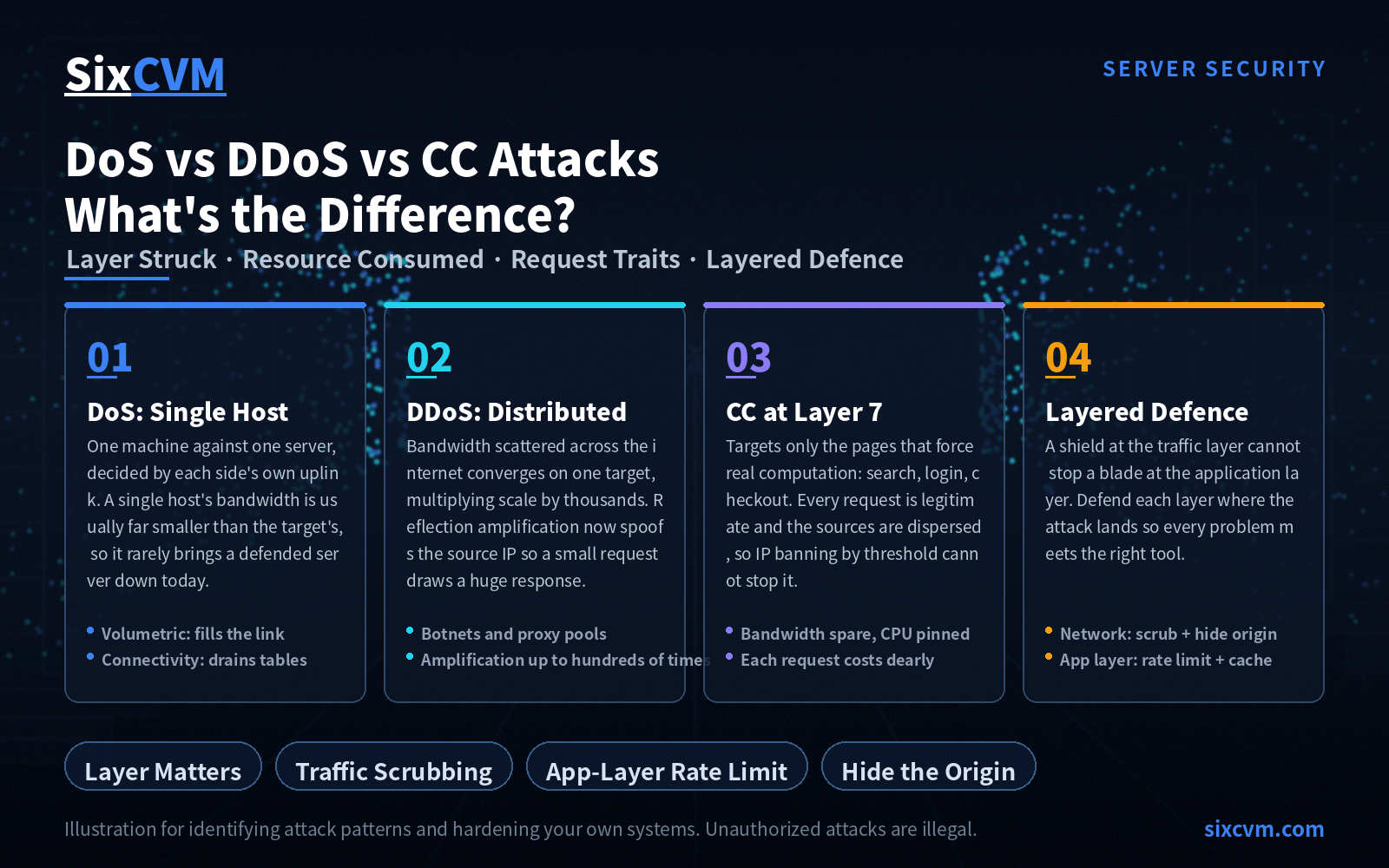
DoS is the original form — one machine against one server, a straight contest of resources.
-
DDoS turns "one machine" into "a swarm". The attacker is no longer limited by their own uplink, but commands hundreds or thousands of compromised machines to strike at once.
-
CC changes the target altogether. It stops competing on traffic volume and instead goes after the pages that force the server to do real computation, trading minimal resources for maximum cost on the other side.
Follow that thread and several counter-intuitive situations start to make sense. Why, for instance, can an attack of just a few dozen megabits per second take down a perfectly well-configured server? Because what it exhausts is the connection table — and the capacity of a connection table has nothing to do with how wide the pipe is.
What decides whether any defence works is always the same two variables: which layer the attack occurs at, and which resource it depends on.
2. The Three Side by Side
|
Dimension |
DoS |
DDoS |
CC |
|---|---|---|---|
|
Source |
Single host |
Distributed (botnet / proxy pool) |
Distributed (mostly proxy pools) |
|
Layer struck |
Network / transport |
Network / transport |
Application (layer seven) |
|
Resource consumed |
Bandwidth, connection table |
Bandwidth, connection table |
CPU, database connections, request-processing capacity |
|
Request characteristics |
Usually plainly anomalous |
Usually plainly anomalous |
Entirely legitimate |
|
Typical scale |
Small |
Large, up to terabit scale |
Small traffic, expensive individual requests |
|
Traditional defences |
Partly effective |
Scrubbing effective |
Scrubbing largely ineffective |
|
Detection difficulty |
Low |
Low |
High |
The last two rows deserve the most attention. The detection difficulty and the application-layer position are precisely why CC cannot be handled with the toolkit built for DDoS.
3. DoS: The Original Single-Host Form
DoS stands for Denial of Service. Its goal is not to steal data but to stop the target from serving normally — the name gives that away.
By what it consumes, DoS splits into two families:
-
Bandwidth attacks: flood the target's outbound link with packets so ordinary users cannot get through.
-
Connectivity attacks: leave bandwidth alone and instead exhaust finite connection resources — connection tables, session counts, process limits. The traffic volume may be modest, yet the impact is just as severe, because what is being attacked is a ceiling rather than a pipe.
One reality needs stating plainly: on today's public internet, a single-host DoS can rarely bring down a properly defended server. The reason is mundane — an attacker's own uplink is usually far smaller than the target's access bandwidth, so throwing a few dozen megabits at several gigabits simply does not scale. DoS today exists mainly as a concept and a starting point; the damage done in the wild comes from its scaled-up form.
It is still worth understanding, because it reveals the essence of this whole family of attacks: what matters is never "how many machines", but "consuming your finite resources at a cost that is asymmetric in the attacker's favour". That essence runs through DDoS and CC alike.
4. DDoS: Turning Scale Into a Weapon
DDoS is DoS with a D in front — Distributed. The entire essence lies in that word.
The principle is not complicated: through a botnet or proxy pool, the attacker concentrates bandwidth and connection resources scattered across the internet onto one target. One machine cannot make a dent; ten thousand suddenly produce ten thousand times the uplink. The victim's egress pipe is only so wide, and with that many sources pouring in simultaneously it saturates quickly.
Two modern evolutions deserve separate mention:
First, reflection amplification. The attacker spoofs the victim's IP address and sends a small request to an open service on the internet (a DNS resolver, NTP, memcached and so on). Those services then send a response amplified tens or even hundreds of times to the victim. This means an attacker can generate a traffic peak far beyond their own bandwidth at minimal cost — and it explains the puzzled question "my link is only 100 Mbps, how am I being hit by several gigabits?" The traffic never had to come from the attacker at all.
Second, the target has moved upstream. Beyond hitting a website directly, attackers now target DNS services and the upstream links of a data centre — moving the attack position higher so the victim cannot even reach the entrance. No software installed on the server itself will help against that; only upstream infrastructure capacity can absorb it.
Handling DDoS is comparatively straightforward. This traffic differs visibly from normal visits — sources extremely dispersed, a single port, uniform packet sizes, no complete handshake. Traffic scrubbing exploits exactly those traits to identify and discard it, re-injecting only clean traffic towards the origin. This is the main battlefield for high-defence products.
5. CC: A Precision Strike That Bypasses Traffic Defences
CC is a branch of DDoS, but it moves the strike from the network layer to the application layer — layer seven.
The name comes from Challenge Collapsar, literally "challenge the black hole". The "black hole" referred to early high-defence appliances that simply swallowed traffic. Such a device could absorb a flood, but faced with an endless stream of legitimate requests it could only pass everything or block everything — leaving a gap in coverage. CC exists to exploit precisely that gap.
The method: mobilise a large pool of proxies or compromised hosts to keep requesting the resources that force the server to compute — search endpoints, login endpoints, list pages that join several tables, checkout flows. Individually these requests look harmless, but each one compels a database query and a page render on the other side.
Three traits make CC particularly awkward to defend against:
-
The requests are legitimate. The source IPs are real, the packets well-formed, every parameter present. There is nothing in a signature database to match.
-
The sources are widely dispersed. Each IP sends only a handful of requests. Ban by threshold and the attacker escapes untouched while legitimate users get caught in the crossfire.
-
The cost is deeply asymmetric. A request costs the attacker almost nothing; handling it costs you a database query and a render. Correcting that asymmetry is what the defence is for.
That is why CC produces symptoms completely unlike a traffic flood: bandwidth still has plenty of headroom, while CPU and database connections are already exhausted.
6. Why High-Defence Protection Stops DDoS but Often Not CC
This is the single most important section in this article.
The core function of high-defence products is traffic scrubbing: identifying anomalous traffic at the network layer (by source distribution, packet characteristics, protocol compliance), diverting it to a scrubbing centre for disposal, and re-injecting only clean traffic to the origin.
That logic is effective against DDoS, because DDoS traffic genuinely looks like an attack.
Point it at CC, however, and the problem appears immediately: every request CC delivers is legitimate, the sources are dispersed and real, and packet lengths and protocols are entirely normal. The scrubbing appliance has no grounds on which to classify it as an attack. Unable to classify, it cannot block. Worse, such attacks may run at only a few hundred requests per second — far below any "abnormal traffic" alert threshold — so dashboards stay calm while CPU quietly climbs to saturation.
The conclusion is direct: a shield at the traffic layer cannot stop a blade at the application layer. Defending against CC requires a different toolkit, and one that takes effect in the application layer.
7. Layered Defence: Meet Each Layer With the Right Tool
The correct approach is not to hunt for a single appliance that cures everything, but to defend each layer where the attack occurs:
|
Layer |
Attacks faced |
Primary measures |
|---|---|---|
|
Edge (network) |
Volumetric DDoS, reflection amplification |
Bandwidth headroom, traffic scrubbing, Anycast distribution, hiding the origin IP |
|
Transport |
SYN floods, connection exhaustion |
SYN cookies, shorter timeouts, per-IP connection limits |
|
Application |
CC, HTTP floods, malicious crawlers |
WAF, source-based rate limiting, CAPTCHA, behavioural analysis |
|
Business |
Concentrated requests to expensive endpoints |
Caching and static output, query optimisation, graceful degradation, queue-based smoothing |
Across those four layers, the first two can be delegated to your provider and specialised appliances. The last two you must handle yourself — only you know which endpoints are expensive and which pages genuinely require live computation.
One frequently overlooked point: making requests cheaper is itself a form of defence. If a search endpoint can absorb a thousand requests per second from cache, an attacker must invest tens of times the resources to produce the same effect, and the economics of the attack collapse. That is far better value than simply buying more bandwidth.
8. Quick Reference: From Symptom to Direction
|
Symptom |
More likely |
Check first |
|---|---|---|
|
Connections fail, frequent timeouts, bandwidth curve spikes |
DDoS (volumetric) |
Egress bandwidth graph, NIC packet rate |
|
Connection table full, every new connection fails |
DDoS (connectivity / SYN) |
|
|
Bandwidth normal but CPU pinned |
CC, or a local resource problem |
Connection counts grouped by source IP, top paths in the access log |
|
Search or login pages hit at high frequency |
CC |
QPS and cache hit rate on that endpoint |
|
Database connection pool exhausted |
CC |
Slow query log, endpoint invocation volume |
9. Frequently Asked Questions
Q1: Between DoS and DDoS, which is the more serious?On today's public internet a single-host DoS rarely causes real damage; almost all damage in the wild comes from DDoS. But DoS remains worth understanding — it reveals the essence: what matters is never "how many machines", but consuming your finite resources at an asymmetric cost.
Q2: Can one solution cover all three?No. DDoS is mainly answered by traffic scrubbing, CC by application-layer rate limiting and caching, and the older "block the packets at the firewall" approach from the DoS era is largely useless against CC. A single solution that does everything is marketing language, not technical fact.
Q3: I bought high-defence protection — why did CC still take me down?Because high-defence protection acts at the network layer, whereas CC's characteristics live at the application layer. Defending against CC means rate limiting, verification and caching on the application side, combined with a CDN that hides the origin IP so the attacker cannot even find where to aim.
Q4: CC traffic looks small — why is it so damaging?Because it attacks processing cost, not bandwidth. A few hundred requests per second, each triggering three database queries and a complex page render, is more than enough to keep a normally configured server fully occupied.
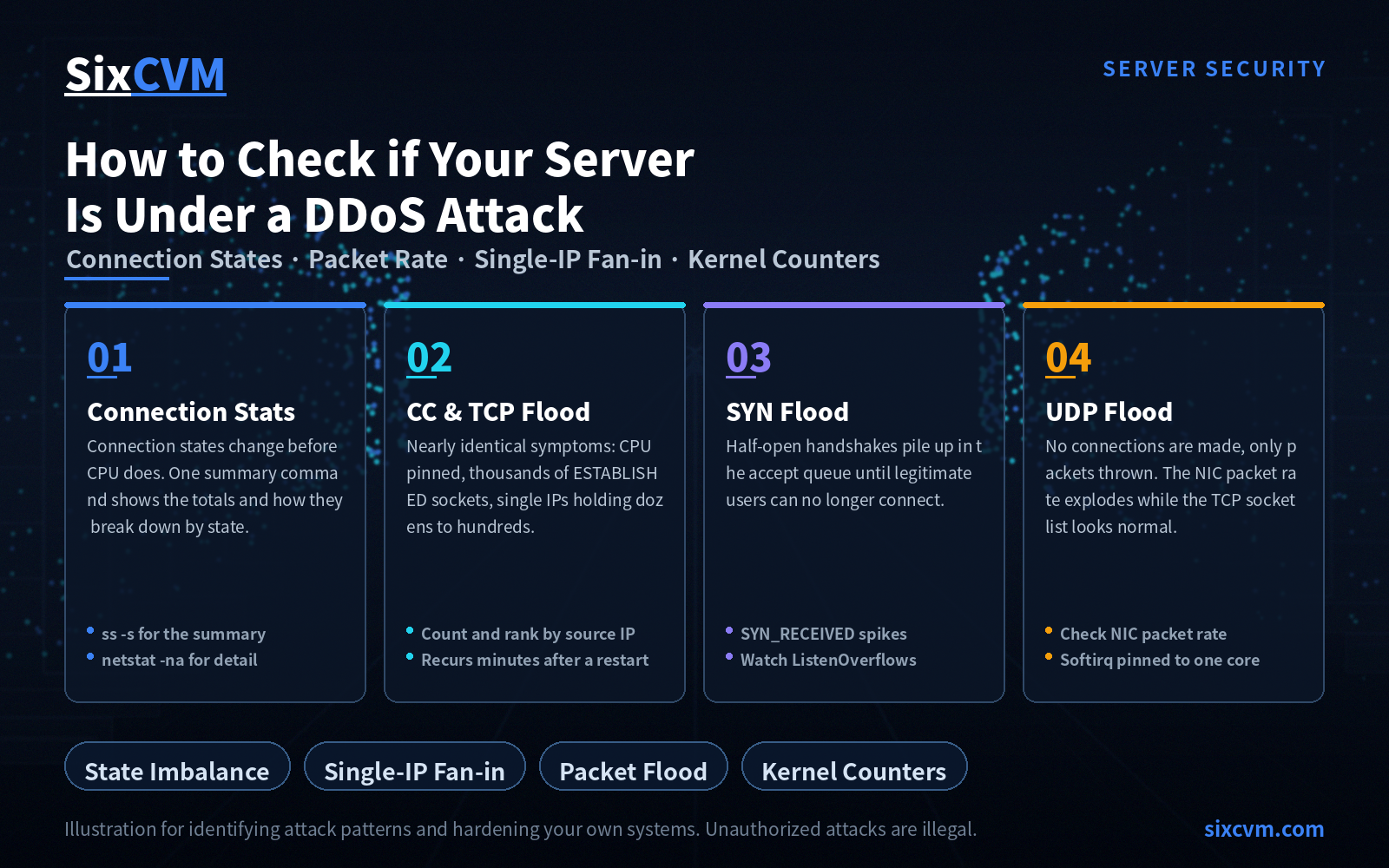
Q5: How do I quickly tell which one I am facing?Watch two indicators first: the bandwidth curve and CPU usage. Bandwidth saturated with CPU low points to volumetric traffic; bandwidth flat with CPU pinned points to the application layer. Then check connection states — a spike in SYN_RECEIVED essentially confirms a half-open connection attack. Diagnosing the direction before acting is far more effective than restarting straight away.
Q6: Is the protection included with a cloud server enough?Cloud follows a shared responsibility model: the provider secures the network and virtualisation layers, while everything inside the instance — patches, open ports, code efficiency, rate-limiting policy, caching configuration — is yours. Baseline protection absorbs a great deal of opportunistic traffic, but it will not save an uncached slow query.
About SixCVM
SixCVM is a cloud server provider built for cross-border businesses and latency-sensitive workloads, operating six core nodes across Hong Kong, Japan, the United States, Korea, Singapore and Vietnam on CN2 GIA and BGP-optimised routes, with Hong Kong latency as low as 10 ms. Its product range covers cloud servers (VPS), GPU servers (NVIDIA A100 / H100 / RTX series), dedicated servers, bare-metal servers and domain registration, all with NVMe SSD storage, minute-level provisioning, elastic scaling, snapshot backups and load balancing.
For the denial-of-service risks discussed in this article, SixCVM provides baseline network-layer protection that covers a substantial share of volumetric DDoS scenarios, and lets you scale bandwidth and compute elastically during traffic peaks so a single instance's capacity never becomes the first bottleneck. Load balancing spreads requests across multiple instances, and the bundled domain registration service consolidates resolution entry points, together buying more headroom for application-layer resilience. Snapshot backups and rapid reprovisioning ensure you can return to a clean state quickly after a compromise. Together with a 99.9% SLA and 24×7 technical support, that adds another layer of protection for business continuity.
This article helps users recognise attack patterns and harden their own systems. Attacking or testing any server you do not own is illegal.
Related reading: browse the full SixCVM Server Security Center for guides covering protection, detection and incident response.