What Does High Concurrency Demand from a Server? Five Performance Requirements and a Load-Balancing Plan | SixCVM
Bottom line first: Whether you can survive high concurrency depends on the weakest of five layers — CPU, memory, network, database, and architecture. Piling more specs onto a single machine will not fix it; closing the gap in the weakest layer will.

1. What High Concurrency Really Tests
When a flood of requests arrives in the same second, a server faces three pressures at once: compute has to keep up, connections have to stay open, and data has to be read and written quickly. Plenty of systems run smoothly day to day and then collapse during a sale event, a game launch, or a livestream peak. The cause is rarely a single failing part — it is a mismatch between the layers.
2. Five Layers That Must All Meet the Bar
2.1 CPU: It Is About Parallel Capacity, Not Just Clock Speed
Under high concurrency, requests are split into a large number of small tasks that can run at the same time. At that point, core count, hyper-threading support, and cache size matter more than a raw frequency number. Too few cores and tasks simply queue up; plenty of cores at a very low clock speed and each individual request gets slower. Match the choice to your workload — long-lived connections or short burst requests.
2.2 Memory: Every Connection Eats Into It
Every active connection, every running process, and every cache hit consumes memory. As concurrency rises, running short triggers swap, and performance falls off a cliff. The practical rule is to reserve capacity based on peak connection counts rather than average daily traffic.
2.3 Network: Bandwidth Is Only the Entry Ticket — PPS and Connection Counts Matter More
Many people fixate on the bandwidth figure, but what actually becomes the choke point under high concurrency is packets-per-second (PPS) handling and the concurrent connection limit. However much bandwidth you have, if the NIC and kernel parameters cannot sustain a flood of small packets, you still get packet loss, retransmissions, and surging latency. Route quality matters too, especially for cross-border business.
2.4 Database: Read/Write Splitting, Indexing, and Caching
For database-backed applications, this is usually where the bottleneck appears first.
-
At the architecture level, implement read/write splitting and, where needed, sharding
-
Design indexes properly to avoid full table scans
-
Serve hot data from cache in front of the database to cut the number of queries that reach it
Get these three right and the database's concurrent capacity improves noticeably.
2.5 Architecture: Load Balancing, Clusters, and Elastic Scaling
A single machine has a hard ceiling; a real high-concurrency plan always scales horizontally.
-
Load balancing spreads requests evenly across multiple backends and prevents any single node from being overwhelmed
-
Clustering raises overall availability so one failed machine does not take down the service
-
Elastic scaling handles traffic peaks — scale up at the peak, scale back at the trough
Handle this layer well and the pressure on the other four is spread much thinner.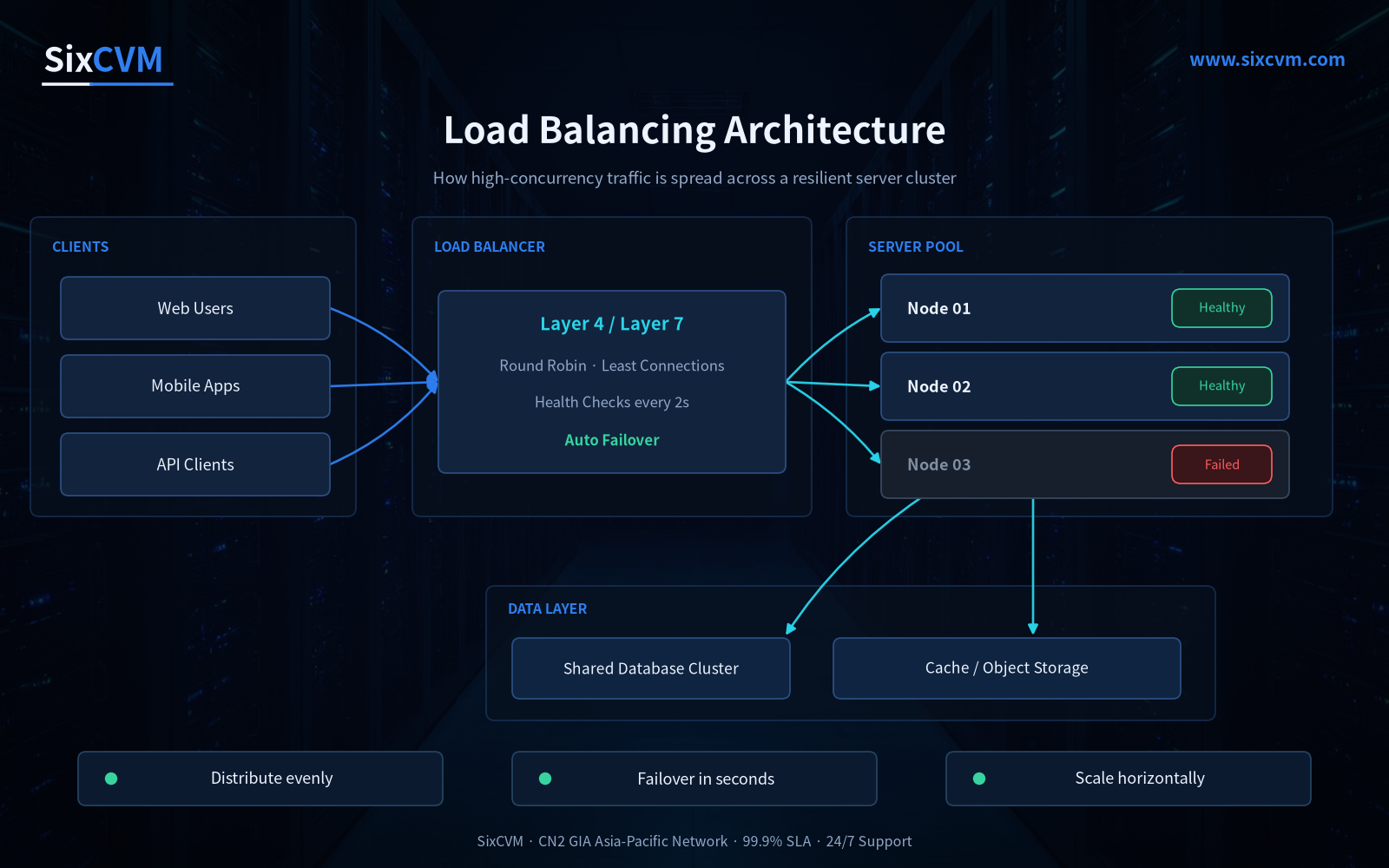
3. Self-Check Table
|
Layer |
Healthy Signal |
Common Bottleneck |
|---|---|---|
|
CPU |
Multi-core with stable clocks, smooth load curve |
Too few cores, requests queueing |
|
Memory |
No swap activity, high cache hit rate |
Insufficient memory triggering swap |
|
Network |
Low packet loss, PPS headroom |
Inadequate small-packet handling |
|
Database |
Few slow queries, read/write already split |
Full table scans, single-node writes |
|
Architecture |
Can add machines horizontally at will |
Single point of failure, cannot scale |
4. Common Misconceptions
-
Upgrading only the CPU while ignoring memory and network — the bottleneck just moves elsewhere
-
Assuming more bandwidth equals more concurrency, while ignoring NIC and kernel packet handling
-
Skipping database indexes and trying to brute-force it with more machines
-
No load balancing, with every request hitting a single machine
5. Summary
Meeting high concurrency is fundamentally about bringing five layers up to a matched standard at the same time: CPU supplies parallel compute, memory carries connections, network guarantees transport, the database absorbs read and write load, and the architecture enables horizontal scale-out. Evaluate all five when you design a system, and it will stay stable under high concurrency — instead of forcing you into firefighting at every traffic peak.
About SixCVM
SixCVM is a global cloud server provider built for cross-border business, operating seven core nodes across Hong Kong, Japan, the United States, Korea, Singapore, Taiwan, and Vietnam over CN2 GIA / BGP optimized routes, with Hong Kong latency as low as under 10ms. Its product line covers cloud servers (VPS), GPU servers (NVIDIA A100 / H100 / RTX), dedicated servers, bare metal servers, and domain registration — all on NVMe SSD storage, with minute-level provisioning, load balancing, and elastic scaling, backed by a 99.9% SLA and 24/7 technical support. It is built to handle high-concurrency scenarios such as major sale events, livestreams, and game launches.